Why LLMs Are Fundamentally Problematic in Safety-Critical Systems
Large Language Models are powerful tools for text generation, but they introduce structural risks when used in safety-critical or regulated environments.

Large Language Models are powerful tools for text generation, but they introduce structural risks when used in safety-critical or regulated environments under ISO 26262 and SOTIF.
Key issues
- Non-deterministic behavior
- Lack of formal guarantees
- Hallucinations without verifiable causal chains
- No direct path to certification under ISO 26262 or ISO 21448
What regulated domains require
In domains such as automotive, aerospace, and defense, systems must be deterministic, verifiable, traceable, and certifiable. This is why purely statistical AI approaches struggle in these contexts.
Alternatives exist
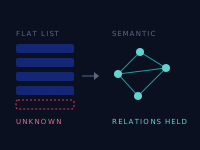
Model-based, symbolic, and declarative AI approaches can transform natural language into formal representations that allow reasoning, verification, and compliance with safety standards.
The future of AI in regulated industries is not about replacing engineering rigor. It is about restoring it.