Services / SVC / RISK
Autonomy System Risk Evaluation
Structural risk in the architecture, not in the backlog.

Autonomy systems rarely fail because of single bugs. They fail when structural assumptions break under edge conditions.
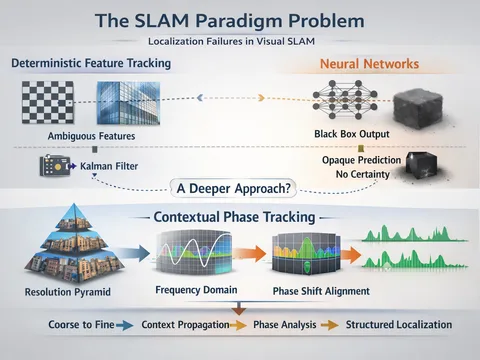
This evaluation covers failure modes in feature-based SLAM, ambiguity in repetitive environments, drift accumulation and graph instability, black-box perception risks in safety-critical contexts, and certification constraints under ISO 26262 and SOTIF.
Services offered
- Feature ambiguity. Repetitive visual structures, for example industrial environments and structured facades, increase feature confusion and graph inconsistency.
- Observability limits. Kalman-based systems degrade when state variables become partially unobservable under sensor degradation.
- Sensor fusion instability. Misaligned timestamps, IMU drift, or LiDAR occlusion can destabilize pose estimation.
- Implicit neural estimation. End-to-end models introduce interpretability gaps that complicate safety validation.
- ODD boundary violations. Performance outside the defined Operational Design Domain often degrades non-linearly.
- Certification mismatch. Architectures optimized for benchmarks may not support traceability and audit requirements.
How we work: risk evaluation framework
Autonomy risk evaluation follows a structured engineering process.
- System decomposition. Separate perception, localization, mapping, and planning layers.
- Assumption mapping. Explicitly document environmental, sensor, and motion assumptions.
- Observability analysis. Identify where state estimation becomes unstable or ambiguous.
- Certification alignment. Evaluate traceability, determinism, and safety argumentation feasibility.