Track record
25 year professional career, 15+ years in safety-critical systems
Independent risk evaluation for perception, localization, and sensor fusion stacks that have to survive both the real world and a certification audit.

Not in the feature list. In the assumptions nobody wrote down, the failure boundaries nobody defined, and the evidence nobody can produce when the assessor asks for it.
Self-assessments you can run yourself. No sales call attached, no email wall. If the result looks uncomfortable, that is the point.
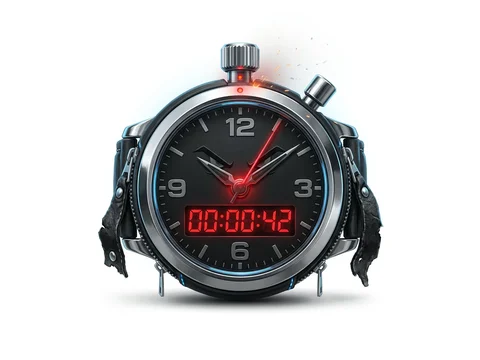
A self-hosted time-tracking and resource-planning tool for startups and small teams. Live timer, budget-vs-actual analytics, team sentiment, all on your own server. Free community edition plus a Pro version.
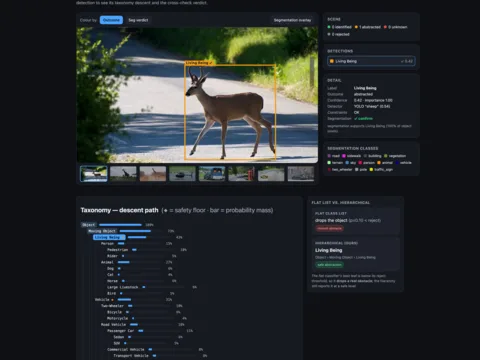
Flat object lists drop what they have not seen before. This demo abstracts each detection up a semantic taxonomy to the most specific level it can safely justify, and cross-checks it with an independent segmentation path.
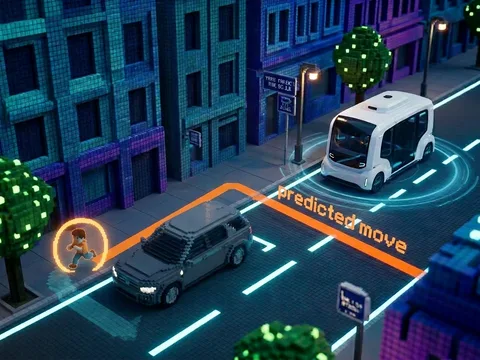
A perception stack that classifies each frame on its own is a snapshot machine with no memory. This project fuses several sensors over time into one persistent 3D driving context, where probabilistic and deterministic paths cross-check each other and static scene is separated from moving objects.
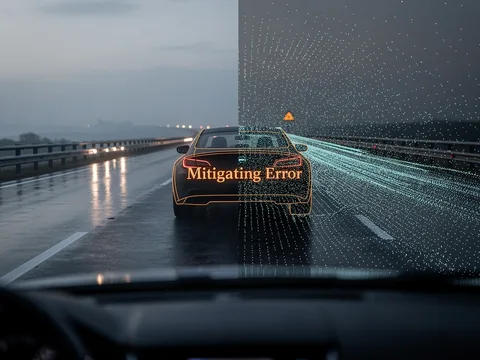
A new peer-reviewed, open-access paper in Discover Artificial Intelligence (Springer Nature) sets out a runtime monitor ensemble that supervises AI-based perception during operation, giving a defensible basis for the safe release and series operation of autonomous driving functions under SOTIF.
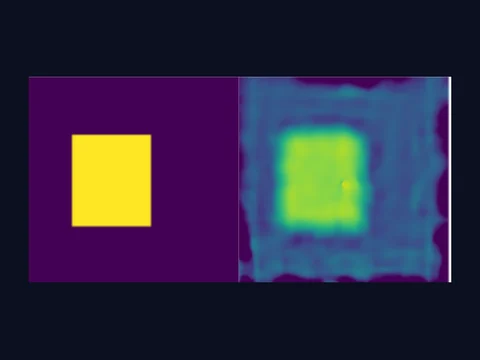
Formal motion estimation is dismissed as good only for small motion. A benchmark against pixel-exact ground truth shows that is false: large scaling and rotation are solved to sub-pixel accuracy. The real ceiling is the affine assumption, and it collapses at exactly the depth boundary that 3D reconstruction is made of.
Most perception stacks reason one frame at a time. The network detects, tracking is bolted on afterwards, and the system never really carries the world forward. A snapshot machine cannot validate cleanly, because the thing that would make its output trustworthy is the thing it discards between frames: continuity.
More than 15 years in safety-critical software and autonomy programs, on top of a longer trajectory through computational graphics, SLAM research, and formal verification. My work covers robustness under real-world constraints, certification feasibility under ISO 26262 and ISO 21448, and the architectural boundaries of modern perception.
Autonomy systems rarely fail because a feature is missing. They fail because a structural constraint was never examined.
Localization, SLAM, sensor fusion, and safety-critical architecture, read at the level where the failure modes actually live.
Explicit assumptions, traceable decisions, defined failure boundaries. Everything else is opinion with a slide deck.
No tool to sell, no platform to defend. The evaluation says what it finds.
Thirty minutes, no pitch. Either there is a structural problem worth your time and mine, or there is not, and I will say so.