The Shampoo Bottle Paradox: Why More Data Cannot Close the AI Autonomy Gap
You cannot solve an undecidability problem by scaling quantity. Decidability is bounded by the informational resolution of the observer.
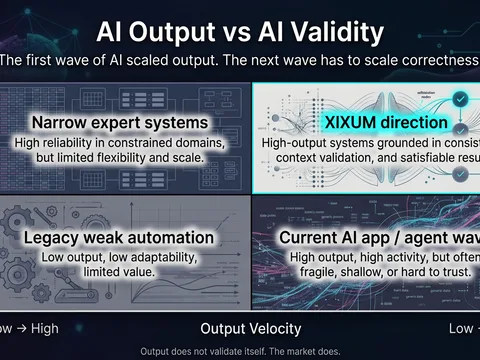
The autonomous systems industry is currently suffering from a profound epistemological illusion. The dominant operational paradigm assumes that we can brute-force open-world safety, specifically within SOTIF regimes under ISO 21448, by running infinite simulation loops, gathering more data, and refining statistical approximations.
This is a structural category error. You cannot solve an undecidability problem by scaling quantity.
In a recent and highly publicized signal paper, system theorists have correctly pointed out the autonomy gap, classifying contemporary deep learning models as mere proposal generators that mistake statistical probability for truth. Pointing out this structural bottleneck is a step in the right direction, but pointing out a gap is not the same as closing it.
The core deficit: scale-dependent decidability
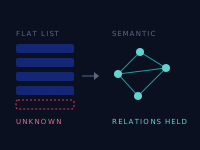
Contemporary deep neural networks operate as ungrounded, inductive engines. Because they evaluate data points autarkically, they are fundamentally incapable of calculating their own semantic ignorance. This architectural blind spot is captured by two real-world phenomena.
1. The phenomenon of superposition, or pattern overlay
Real-world data streams do not present themselves in sterile isolation. A standard traffic sign heavily interfered with by organic occlusion, such as shifting, non-linear shadows cast by tree branches, becomes mathematically undecidable for context-free DNNs. To a raw perception pipeline, a sharp shadow cast across asphalt is mathematically indistinguishable from a solid, painted lane marker. Both exhibit robust structural features within the localized pixel matrix, leading directly to catastrophic SOTIF failures.
2. The shampoo bottle paradox
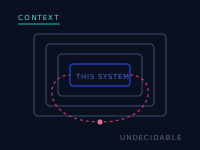
Decidability is fundamentally bounded by the informational resolution of the observer. Observing an object from a distance, the visual pattern uniquely resembles the silhouette of a white horse's head. At that specific lower-resolution tier, the hypothesis "horse" is statistically robust. The data points allow no alternative decision.
Only upon physical approach, which increases the detail depth and granularity, does the hypothesis collapse. The semantic context clarifies, revealing a cosmetic label featuring a collage of magnified hair fibers, oil droplets, and serial typography. The system hallucinated high statistical confidence on a low-resolution pattern that was underdetermined by definition.
When a system lacks a contextual, deterministic meta-structure to actively disentangle environmental noise before it propagates to the execution layer, it remains a sophisticated automation tool. That is far from a real autonomous agent, which requires defendable reasoning.
Shifting the paradigm to intrinsic admissibility
Our preprint framework introduces a strict formal-semantic encapsulation designed to enforce mathematical closure precisely where it matters: at the non-bypassable commit boundary. By shifting the computing paradigm from raw execution optimization to prior admissibility validation, we ensure that an underdetermined visual state triggers a bounce-back to the user to clarify intent.
Stop running endless data loops hoping for emergent certainty. True cognitive AI does not bypass neural perception. It binds it.
Full derivation, cross-domain transfer models, and formal proofs on open-world validation: https://doi.org/10.5281/zenodo.20562409