SLAM Is Not Solved. It Is Just Benchmark-Optimized.
SLAM is benchmark-optimized, not solved. Feature tracking breaks down on repetitive surfaces, and neural depth estimation replaces geometric ambiguity with opacity. Until localization stacks treat context as a first-class structural concern, safety-critical autonomy remains fundamentally fragile.

In autonomy circles we pretend localization is a performance problem. It is not. It is a structural ambiguity problem.
We still rely on two dominant paradigms.
1. Feature tracking plus Kalman-style filtering
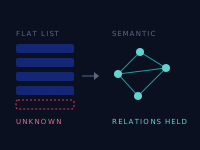
We track isolated contrast points across frames. But those features have no semantic context. Give the system a repetitive facade, a patterned surface, a structured grid, and neighboring features become interchangeable. This was not solved in 2005. It is not solved today. We just made it faster.
2. End-to-end neural depth and motion estimation
We replaced ambiguity with opacity. Now the system predicts pose, but cannot explain it. In safety-critical systems, that is not a minor detail. It is the difference between engineering and gambling.
The uncomfortable truth
Most SLAM stacks optimize error metrics. Very few optimize structural robustness. We measure accuracy. We rarely measure ambiguity propagation across scales.
If localization fails, it rarely fails gradually. It fails catastrophically. And no leaderboard captures that.
A more interesting direction
Instead of tracking isolated features, propagate motion hypotheses across a resolution pyramid. Track phase shifts across frequency bands. Let coarse structure constrain fine detail. Register only deltas between levels.
Context first. Features second.
SLAM does not fail because algorithms are weak. It fails because context is structurally under-modeled. Until we solve that, localization in safety-critical autonomy remains fundamentally fragile.