Why Most Enterprises Get Enterprise AI Wrong, And How to Fix It
Most enterprises harness AI by its tail. A formal maturity model is the only way to build a coherent, governable AI stack, before the mess becomes unmanageable.
Most enterprises approach AI the wrong way around.
They discover a compelling use case, procure a vendor tool, run a pilot, and then try to scale it, only to find that their data infrastructure is not ready, their governance is absent, their talent is fragmented, and their AI investments have quietly become a patchwork of disconnected experiments with no coherent architecture underneath.
They harness the horse by its tail.
The result is what we see across a growing number of enterprise AI environments today: duplicate tools, inconsistent data pipelines, undefined ownership, incompatible models, and no shared framework for deciding which capabilities belong where. What started as a series of fast wins has become a structural liability that is expensive to audit, difficult to govern, and nearly impossible to scale responsibly.
The root cause is almost never technical. It is strategic. The enterprise did not start by asking: what level of AI maturity do we currently operate at, what level do we need to reach, and what is the structured path between those two states?
What a maturity model actually does
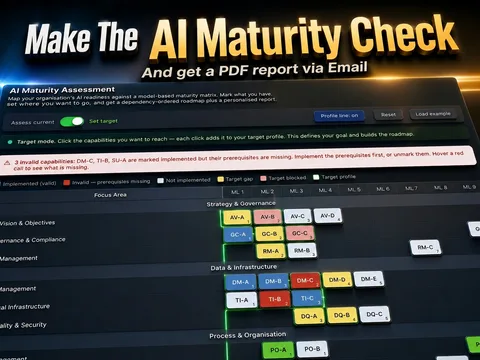
A formal AI maturity model is not a scoring exercise. It is a diagnostic and planning instrument. It maps an organisation across the dimensions that actually determine whether AI can function at scale: data readiness, model governance, operational integration, talent structure, organisational alignment, and infrastructure architecture.
Our approach at FelixSchallerCOM is rooted in a formal maturity model methodology originally inspired by Professor Sjaak Brinkkemper of Utrecht University. It does not assess what tools an enterprise uses. It assesses whether the enterprise has the structural conditions under which those tools can be trusted, maintained, and governed at scale.
The outcome is not a report. It is a roadmap: a prioritised, phased sequence of capability investments that moves the enterprise from its current state toward a coherent, auditable, and governable AI stack.
Why it matters now
Regulatory pressure under frameworks like the EU AI Act is making AI governance mandatory, not optional. At the same time, enterprise AI investment is accelerating. The two forces are on a collision course for any organisation that scaled AI deployment without laying proper structural foundations first.
Cleaning up an ungoverned AI landscape is significantly more expensive than building it correctly from the start. It requires unravelling vendor dependencies, migrating data, reconciling model lineages, and explaining past decisions to regulators without adequate documentation.
The enterprises that will win in AI are not those that move fastest. They are those that establish structural clarity early, and use a maturity framework to make their investments compounding rather than cannibalistic.
What we offer
We work with enterprise teams to conduct structured AI environment audits, score current maturity across all relevant dimensions, identify the highest-risk gaps, and develop a prioritised AI stack roadmap aligned with the organisation's strategic objectives and regulatory context.
This is not advisory in the abstract sense. It is a formal assessment based on defined criteria, producing a concrete deliverable: a roadmap your team can execute.
[Link on import: whitepaper, AI Introduction Strategy, Client Edition, PDF.]