Autonomy Is Underestimated Because Governance Is Missing
Autonomy built on probabilistic systems needs supervision, guardrails, and governance until AI can verify its own outputs.

Autonomy is underestimated for the wrong reason.
Most people still evaluate autonomous systems as if the hard part is only perception, planning, or model performance. Better sensors. Larger models. More training data. Faster inference. That view misses the real bottleneck.
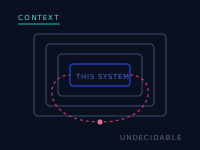
Autonomy does not fail only when it cannot produce an output. It fails when nobody can verify whether the output should be trusted.
This is why autonomy needs guardrails. Not as decorative compliance. Not as a policy document attached after deployment. Guardrails need to be part of the runtime architecture: constraints that define what the system is allowed to do, confidence thresholds that determine when it must stop, and escalation paths when uncertainty becomes too high.
But guardrails alone are not enough. A system can follow rules and still be wrong. It can satisfy local constraints while violating the broader intent. It can produce something plausible, efficient, and technically valid, while still being unsafe, unaccountable, or misaligned with the operating context.
That is where a governance layer becomes essential.
The governance layer is the part of the system that asks: who verifies the output? Against which criteria? With what evidence? Under which authority? And what happens when the system is uncertain, contested, or wrong?
Autonomy without governance becomes automation theater. It looks powerful because it acts independently. But independence without verification is not intelligence. It is unmanaged delegation.
The underestimated opportunity is not simply building more autonomous agents, robots, or decision systems. The opportunity is building the layer that makes autonomy auditable, bounded, explainable, reversible, and governable.
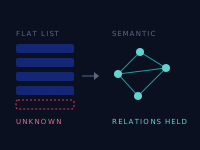
In practice, that means every autonomous output should carry more than a result. It should carry a trace: what inputs mattered, what assumptions were made, what alternatives were rejected, which constraints were checked, and where human or institutional review is required.
This connects directly to my Medium article, "True Autonomy Requires Cognitive AI That Can Verify Itself". The article argues that probabilistic AI is useful under supervision, but dangerous as the foundation for autonomous action. In the chatbot era, humans quietly supplied the validation layer. In unsupervised autonomy, that layer disappears, and the risk moves from wrong answers to uncontrolled machine action.
That is why this piece focuses on governance. If current architectures cannot verify their own outputs, autonomy needs external guardrails, review authority, and eventually formal-semantic or neurosymbolic systems capable of self-verification.
The next generation of autonomy will not be defined only by who can act fastest. It will be defined by who can verify action at scale. That is the missing layer. And it may become the most valuable part of the stack.