Autonomous Flight Is a Solved Problem. Autonomous Driving Is Not.
The difference is not engineering effort. It is geometry, physics, and the dimensionality of the operating environment.
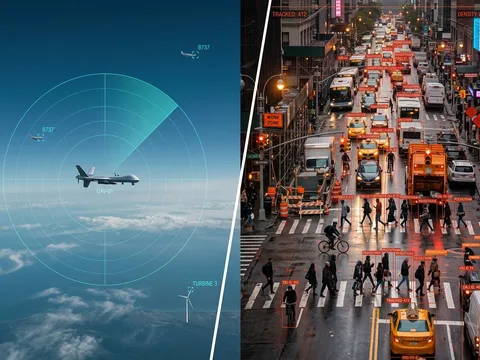
This is a consequence of geometry, physics, and the dimensionality of the operating environment.
The obstacle problem
In flight, obstacles are sparse, static, and well defined. Buildings, wind turbines, power lines, all charted. Other aircraft follow trajectories extrapolated from tracking history with high confidence. Birds and rogue UAVs are reliably detected by Doppler radar even in fog.
On the ground, the obstacle problem is unsolved in the general case. Pedestrians, construction zones, wet surfaces, night scenarios, edge cases no training dataset has ever seen. The industry's answer has been scale: millions of logged kilometres, massive datasets, safety cases built on statistical coverage. Most autonomous vehicles today operate under strict conditions, permanently connected to a human operator who can intervene when the system is overwhelmed. None of this is needed in autonomous flight.
The dimensionality problem
An autonomous car operates in approximately 1 to 1.5 dimensions. It follows a road. Lateral freedom exists only at intersections, a fractional dimension in the mathematical sense. A ship operates in 2D. An aircraft operates in 3D, with full freedom across all three axes. Higher dimensionality means more separation between objects and simpler conflict resolution.
The compute consequence
Autonomous driving requires sensor fusion across LiDAR, camera, radar, and ultrasonic systems with full 360 degree coverage. The compute budget is enormous. Autonomous flight at UAV scale needs GPS, a charted obstacle map, and Doppler radar, mutually redundant, low enough to run as a parallel process on modest embedded hardware.
The certification consequence
Automotive safety cases are built on millions of kilometres of real-world data because the scenario space is effectively unbounded. Aviation safety cases are built on physics and bounded airspace, a fundamentally more tractable problem.
This is why autonomous cargo drones are flying commercial routes today while fully autonomous passenger cars remain under permanent remote supervision. The sky is easier. The physics demand it.
FelixSchallerCOM provides fractional and interim advisory for teams building autonomy pipelines in UAV, defense, and regulated environments, from perception architecture to safety case strategy.